

Late-stage drug failures remain a significant challenge in the clinical development process, resulting in financial losses and wasted resources. That’s why having a reliable, physiologically relevant in vitro model is crucial for building confidence in a therapeutic candidate before progressing to in vivo and clinical studies.
Primary human hepatocytes (PHHs) have long been an important tool in the early-screening arsenal, with their accurate representation of human liver tissue offering valuable insights into a drug’s pharmacokinetics, efficacy, and potential toxicity. PHHs are also useful for studying a wide variety of liver disease indications — from viral hepatitis and metabolic disorders (such as metabolic associated steatohepatitis and metabolic associated fatty liver disease) to rare genetic diseases including Wilson’s disease, urea cycle disorders, alpha-1 antitrypsin deficiency, and more.
However, the practical limitations of traditionally sourced PHHs — including quality challenges, donor variability, limited stock, and short lifespan in culture— can make them challenging to work with.
Now, a promising alternative source of PHHs has emerged, providing a more cost-effective, high-quality, convenient, and consistent in vitro model.
Primary human hepatocytes: a ‘gold standard’ with numerous challenges
PHHs have long been regarded as the ‘gold standard’ in in vitro liver cell culture1 due to their ability to closely mimic human liver functions and mechanisms, and thus more reliably predict drug responses.
However, despite their widespread use, PHHs derived directly from humans pose several significant challenges:
Sourcing and variability1
Obtaining high-quality PHHs can be difficult, as only a limited number of human tissue samples may be suitable for successful primary hepatocyte isolation. Supply from each donor is also limited, so it is common to need cells from multiple donors across a single study, which require validation to ensure batch consistency.
Furthermore, variations in donor characteristics, the sourcing of the liver tissue (e.g., surgical resections, organ donations, or biopsies), and the methods used to isolate the hepatocytes can affect the quality of the cells, impacting drug responses and study reproducibility.
High costs
The complexities of sourcing, the limited supply of donors and suitable samples, and the need for multiple validations across a study can make traditional PHH cell models expensive to use (Table 1), particularly in long-term research.
|
Commercial Vendor PHHs Grades and Costs |
|
|
Hepatocyte Grade |
Cost per vial |
|
Plateable grade |
$1,400–$1,650 |
|
CYP-induction certified |
$1,450–$1,700 |
|
Transporter certified |
$1,650–$2,350 |
Plateability challenges
Not all traditionally sourced PHHs can successfully adhere to a culture plate. Those that fail to effectively adhere have limited applications, so researchers often need to screen multiple PHH batches to find a suitable lot, extending timelines and increasing costs.
Short lifespan and loss of function
Loss of metabolic function and morphology are commonly observed in PHHs; with PHHs often de-differentiating into mesenchymal phenotypes after just a few days in culture1. PHHs also remain viable for just 1–2 weeks in typical culture. Although advancements such as 3D sandwich cultures extend this lifespan, these methods restrict the type of assays that can be performed, limiting their applications in longer-term research1.
The limitations of PHHs, then, present serious obstacles in in vitro research, introducing variability in experimental outcomes, driving up costs, and potentially slowing down developmental timelines. To address these challenges, researchers need a cell model that retains the advantages of PHHs while overcoming their limitations.
Cryopreserved PXB-cells — an effective solution?
Cryopreserved PXB-cells provide an innovative alternative to PHHs generated from more traditional methods. PXB-cells are ~95% pure primary human hepatocytes freshly prepared on-demand from a proprietary in vivo bioreactor, and closely replicate normal human liver physiology.
Now available in a cryopreserved format, PXB-cells can provide researchers with a convenient, consistent, and accurate in vitro model that offers numerous advantages over traditional PHHs.
Reliable sourcing and reduced variability
As cryopreserved PXB-cells are derived from a proprietary in vivo bioreactor, researchers benefit from consistent donor profiles, minimizing variability between experiments and the need for repeated validations in longer-term studies.
The same high quality as freshly plated PXB-cells
Studies have shown that cryopreserved PXB-cells retain the structure and function of fresh PXB-cells. Post-thaw, they maintain the appropriate morphology and have similar human albumin profiles to fresh PXB-cells (Figure 1).

Figure 1: Morphology and human albumin profiles of cryopreserved and fresh PXB-cells from four different donors.
Additionally, cryopreserved PXB-cells are able to mimic human liver function as effectively as fresh PXB-cells, demonstrating stable cytochrome P450 (CYP) expression and induction and activity of liver transporters (Figures 2 and 3). CYP enzymes can also be induced by Rifampicin, β-Naphthoflavone (BNF), or Phenobarbital in cryopreserved PXB-cells, making them ideal for metabolic studies (Figure 4).
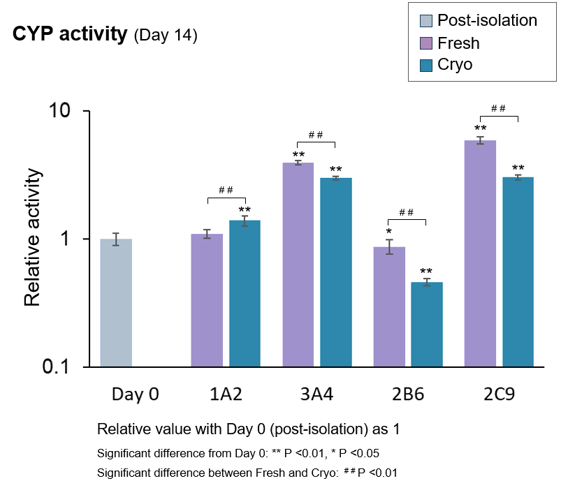
Figure 2: CYP activity in cryopreserved and fresh PXB-cells at Day 14 post isolation.
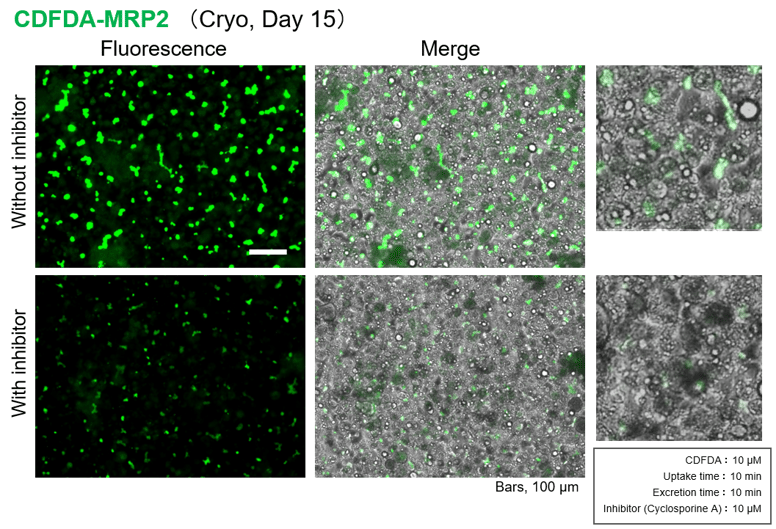
Figure 3: MRP2 Transporter is active in cryopreserved PXB-cells. CDF, a metabolite of CDFDA accumulates in bile canaliculi in cryopreserved PXB-cells (Upper panel). The addition of cyclosporine prevents this accumulation by inhibiting MRP2 (Lower panel).

Figure 4: Comparison of CYP enzyme induction with Rifampicin, β-Naphthoflavone (BNF), or Phenobarbital in cryopreserved and fresh-PXB cells.
Wide-ranging applications
Cryopreserved PXB-cells offer similar quality to fresh PXB-cells post-thaw, meaning that, just like their fresh counterparts, cryopreserved PXB-cells have numerous research applications.
- Gene Editing: Tremblay et al (2024) used an LNP to successfully deliver an epigenetic editor targeting PCSK9 to PXB-cells, resulting in reduced PCSK9 secretion2. In addition, Smekalova et al. (2024) used cytosine base editing in PXB-cells to target the hepatitis B virus (HBV)3.
- Toxicology Studies: In a study examining aflatoxin B1 (AFB1) toxicity, Ishida et al. (2020) found that the sensitivity of the PXB-cells to AFB1 cytotoxicity was comparable to PHHs, supporting their use in hepatotoxicity evaluations4.
- Infectious Disease Research: Ishida et al. (2015) and Gad et al., (2022) demonstrated that PXB-cells are a reliable in vitro model for studying hepatitis B virus (HBV) and hepatitis D virus (HDV) infection5,6.
Extended long-term culture
Cryopreserved PXB-cells cells can survive at least 28 days in culture, showing similar levels of human albumin production to fresh PXB-cells over that period (Figure 5).
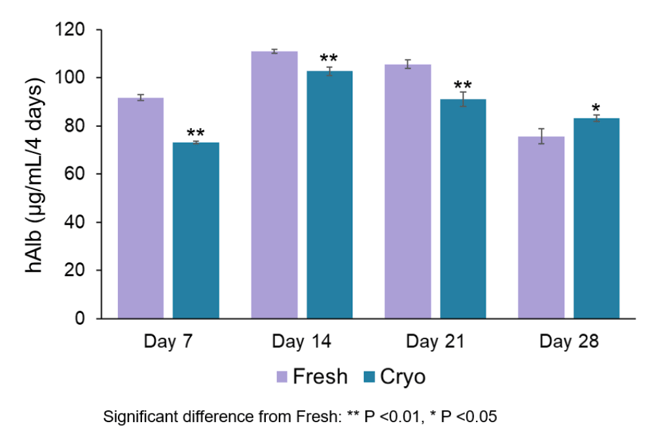
Figure 5: Human albumin production over 28 days in cryopreserved and fresh PXB cells.
Convenience to start experiments on your timeline
Unlike freshly isolated cells, cryopreserved PXB-cells can be stored and used on demand, allowing researchers to initiate experiments according to their schedules. Moreover, researchers can easily plate cryopreserved cells in the format that best suits their assay (fresh PXB-cells, on the other hand, are primarily offered in 24- and 96-well plate and T75 flask formats). This flexibility simplifies study design planning and reduces the logistical challenges associated with fresh PHHs.
Cost-effectiveness
Cryopreserved PXB-cells can be supplied consistently from the same human donor for several years, helping to reduce costs associated with sourcing and batch variability issues associated with traditional PHHs.
Researchers can also bulk order and store cryopreserved PXB-cells for use as needed, lowering shipping costs. What’s more, in vitro work using cryopreserved PXB-cells can pave the way to studies using humanized liver chimeric mouse models generated with the same human hepatocyte donor. This translatability may reduce the risk of unexpected later-stage failure (i.e., during in vivo studies), providing further cost savings.
Optimize drug development with a convenient, reliable in vitro model
Although PHHs derived directly from humans have long been the gold standard for in vitro liver cell studies, their limitations in terms of quality, variability, and flexibility can create significant challenges. PXB-cells — in particular cryopreserved PXB-cells — though, offer an attractive alternative.
With more convenient sourcing and consistent quality, PXB-cells can provide an effective replacement to traditional PHHs, capable of delivering more reproducible results in long term culture. In their cryopreserved format, PXB-cells retain these benefits while offering improved cost-effectiveness and the flexibility to thaw and use the cells as and when needed, as well as allowing researchers to plate them in accordance with their preferred assay.

Contact us to find out more about how cryopreserved PXB-cells can support your research!
References
- Kaur I, Vasudevan A, Rawal P, et al. Primary hepatocyte isolation and cultures: Technical aspects, challenges, and advancements. Bioengineering. 2023. 10, 131. https://doi.org/10.3390/bioengineering10020131
- Tremblay, F., Xiong, Q., Shah, S, et al. A potent epigenetic editor targeting human PCSK9 for durable reduction of low-density lipoprotein cholesterol levels. Nature Medicine. 2025; 1-10.
- Smekalova EM, Martinez MG, Combe E, et al. Cytosine base editing inhibits hepatitis B virus replication and reduces HBsAg expression in vitro and in vivo. J Hepatol. 2024; 81(2): 422-434. doi:10.1016/j.jhep.2024.01.014.
- Ishida Y, Yamasaki C, Iwanari H, et al. Detection of acute toxicity of aflatoxin B1 to human hepatocytes in vitro and in vivo using chimeric mice with humanized livers. Toxicol Appl Pharmacol. 2020; 396:115021. doi:10.1016/j.taap.2020.115021.
- Ishida, Y., Yamasaki, C., Yanagi, et al. . Novel robust in vitro hepatitis B virus infection model using fresh human hepatocytes isolated from humanized mice. The American journal of pathology. 2015; 185(5), 1275-1285.
- Gad, S. A., Sugiyama, M., Tsuge, M., et al. The kinesin KIF4 mediates HBV/HDV entry through the regulation of surface NTCP localization and can be targeted by RXR agonists in vitro. PLoS Pathogens. 2022; 18(3), e1009983.